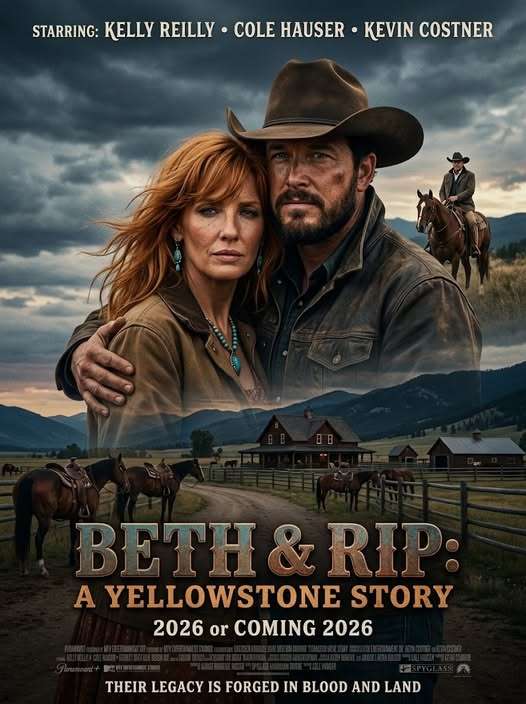
 Creator / Director: Taylor Sheridan
 Starring: Kelly Reilly • Cole Hauser
 Genre: Romantic Drama • Crime • Modern Western
Love as a Survival Contract
Beth & Rip: A Yellowstone Story (2026) can be read as Taylor Sheridan’s most intimate—and most unsentimental—exploration of romantic attachment within the neo-Western. Stripped of dynastic sprawl and political maneuvering, the narrative isolates a single relationship to examine love not as refuge, but as mutual endurance pact. In the world Sheridan constructs, romance is not redemptive; it is operational.
Narrative Reorientation: From Dynasty to Dyad
Unlike Yellowstone, where relationships function as leverage within a broader power economy, Beth & Rip collapses the narrative field to a two-person system. Conflict emerges not from external antagonists alone, but from the internal logic of loyalty, trauma, and self-knowledge. The story advances through accumulation—shared decisions, shared damage—rather than escalation, situating the film within relational neo-Western drama rather than family saga.
Character, Trauma, and Asymmetric Devotion
Kelly Reilly’s Beth Dutton is presented without mitigation. Her volatility is not softened into vulnerability; it is treated as survival strategy refined over time. Beth’s intelligence is predatory, her affection selective, her honesty brutal. Cole Hauser’s Rip Wheeler embodies complementary containment: loyalty without illusion, violence without confusion. His devotion is neither submissive nor sentimental—it is structural. Together, they form a closed ethical circuit in which love is expressed through protection, complicity, and refusal to moralize each other’s damage. The performances reject romantic idealization, privileging coherence over comfort.
Form, Space, and Intimate Brutality
Formally, Beth & Rip tightens Sheridan’s visual language. Landscapes recede from mythic dominance to emotional perimeter; interiors—bedrooms, kitchens, workspaces—carry narrative weight. Cinematography favors low-contrast lighting, close framing, and controlled stillness, reinforcing intimacy under pressure. Violence, when present, is abrupt and functional, never ornamental. Sound design is restrained, allowing silence and environmental presence to underline emotional proximity. The Western aesthetic contracts inward, becoming personal rather than territorial.
Conclusion: Romance Without Redemption
From an academic perspective, Beth & Rip: A Yellowstone Story (2026) functions as a study of romance stripped of its civilizing myth. It rejects the fantasy that love heals trauma or corrects moral imbalance, presenting instead a partnership built on recognition and mutual consent to survive as they are. In Sheridan’s modern West, the most durable relationship is not the most virtuous, but the most honest about its costs. By centering a love story that neither seeks absolution nor promises change, the film reframes romance as a form of shared endurance—one that does not escape the violence of its world, but learns how to live inside it together.